So, I went and kicked off a social media campaign.
In a previous blog post I talked about how I was going to do something for Amazon, since I was inspired by them after a short freelance assignment with them. They had a conference back in December, and another one in January, which took place this week, between Jan 12 – 14.
Well, I did just that. I created a social channel, launched some posts, and now I’m taking a look at the results.
The conference was AWS Re:Invent, and this week they shared about 200 webinars of various professionals in various industries to talk about how they use the various technologies that are featured in AWS to help them in their business. Some of the companies that came to talk included Netflix and Fannie Mae.
Enough stalling, let’s talk about how it went.
The set up
First, I set up a dedicated social media account to just focus on posting about the conference this week.
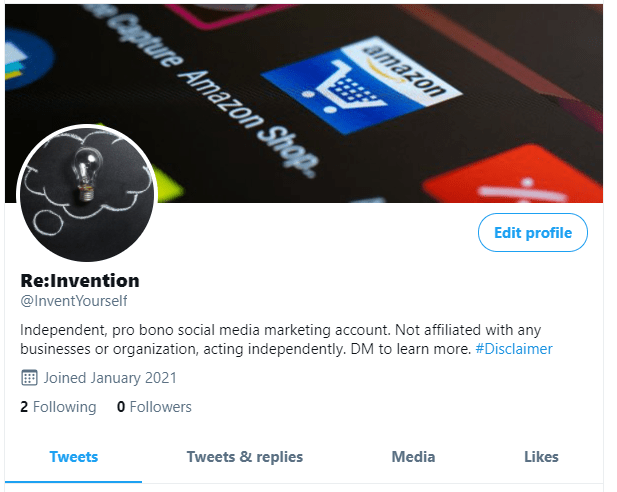
Is it very creative? Probably not. Do I care? No, not at all. The point was to simply have a channel in which to post my content. The cover photo has Amazon right smack in the center – granted, it’s an app that’s not AWS, and it contains an app that this account doesn’t post about at all, but it’s a stock photo, and it still says Amazon right in the middle, and I figure, that’s good enough.
The profile image is of a lightbulb that’s sitting in a cloud. Since AWS is a cloud service, and I found that stock photo, I decided, that’s good enough.
It’s worth noting that I only had a couple days to get this going, so I aimed for Good Enough.
Audit
While I did go through an audit of AWS’s social media, I was fortunate to find that the voice of their content was mostly educational, trying to teach it’s audience something, such as cloud service technologies to help out businesses and industries to function better in the world. AWS does not appear to to aim for creativity, or that emotional connection that some brands aim for, AWS is aiming for educational, technical, and businesses minded.
it’s probably safe to say that AWS is functioning as a B2B company, which is important for someone like myself who has been so accustomed to B2C work. In fact, it didn’t even occur to me to say B2B until this moment as I wrote this paragraph. That also helps to explain to me why AWS is more educational and technical, because AWS is speaking to the audience who has business goals, who have customers in mind.
Goals
It should be stated that I did not have a specific goal in mind when launching this channel and this campaign, I simply wanted to see what would happen, and what I could accomplish in a couple days. So, the goal was to create posts, and to collect data, and see what happens. There was no S.M.A.R.T goal, and the tactics were made on the spot. (After all, like I said, I had a couple days.)
Content
My goal was to create posts that simply called attention to the various webinars at Re:Invent. The copy in each post was to maintain the educational tone, and occasionally infusing my own sense of humor.
Here are some examples:
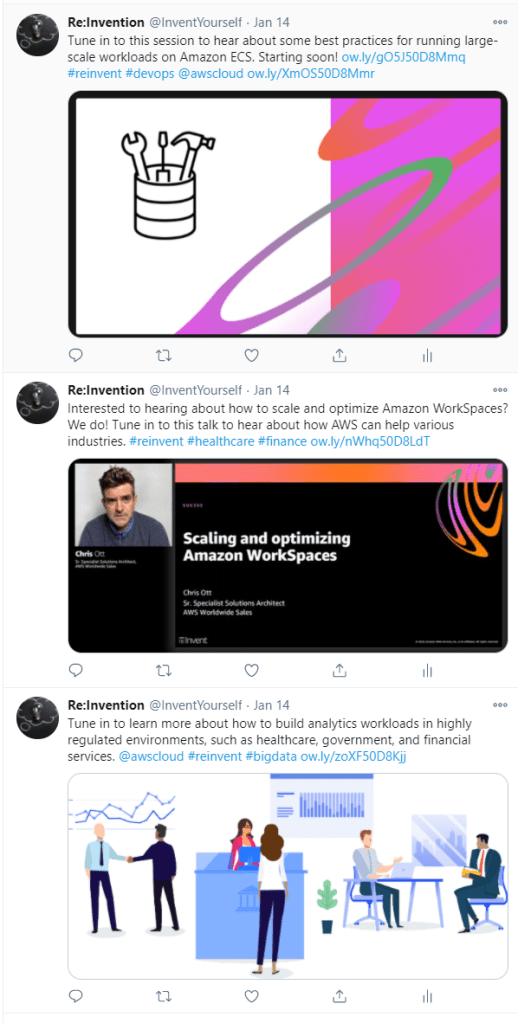
These are pretty boring examples, but that’s totally fine because they share the voice that AWS has in it’s own social media channels.
Ok, sure, but how’d it all do?
The fun part – Results
I am genuinely surprised by the results from my two day stint.
To start, here’s the impressions I gained during these two days.
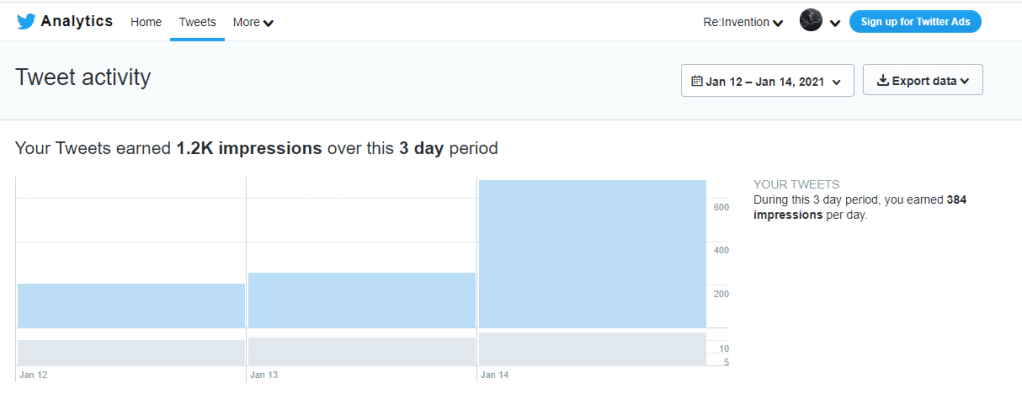
I suppose that 1200 impressions isn’t that big of a number, but I’d say it’s nothing to sneeze at for a Twitter channel that started up on the exact same day that it started launching posts, and has zero followers. 1200 impressions, 384 per day, that’s nothing to sneeze at.
Other metrics, let’s look at the top six posts:
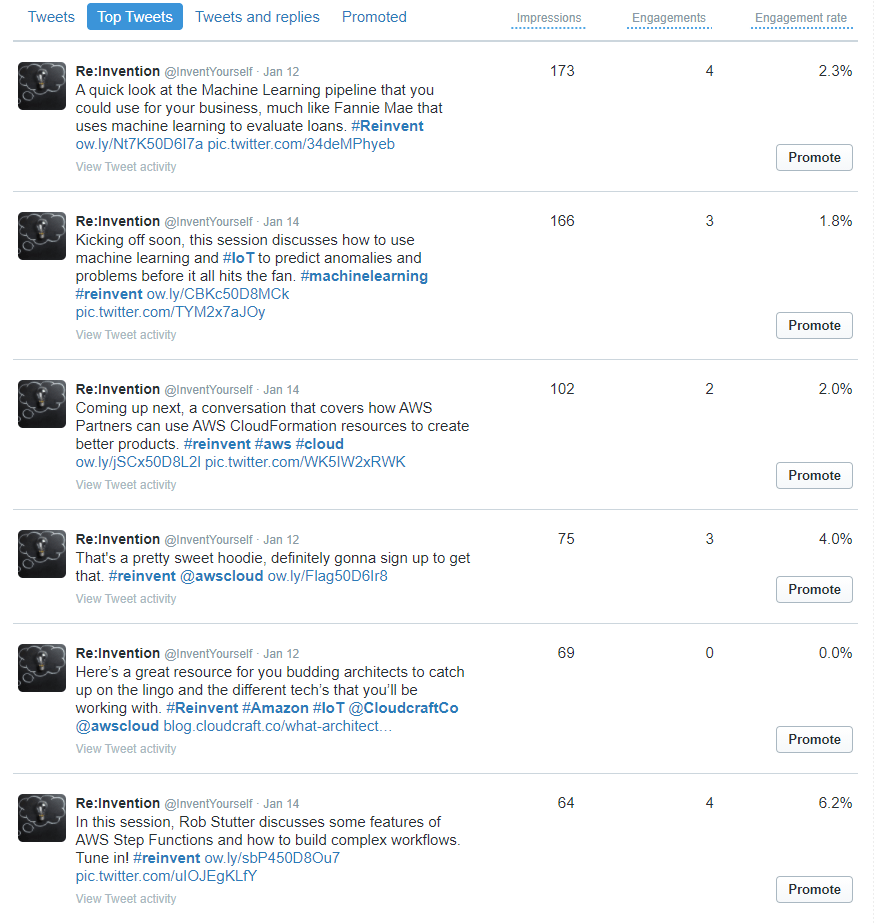
The average number of impressions is about 108, and the engagements didn’t go above 5. However, these posts also got a total of 8 retweets, and about 4 likes. However, it feels like those numbers aren’t telling the whole story. According to Hootsuite:
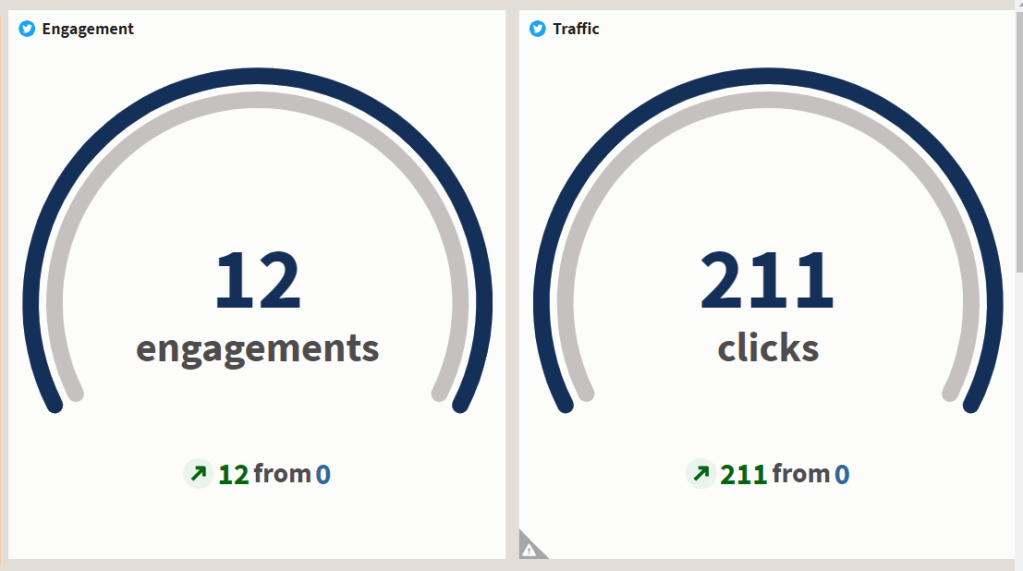
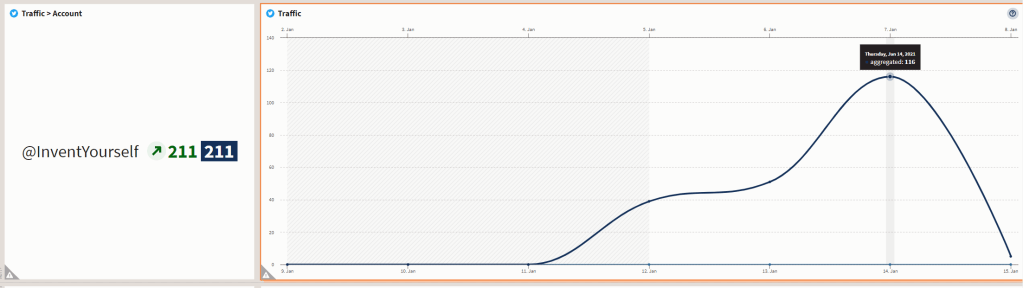
There aren’t a lot of engagements, and it’s unfortunate that a click is not considered an engagement. However, there were 211 times that people said, “wut da fuq is dis??????” So, in this case, Amazon should be grateful that I got them 211 more visits to their webinars than they would otherwise. I’ll accept $100 per click.
(i’m kidding.)
The point is, this choice of voice, use of hashtags, links, and subject matter all contribute to the kind of response on social media that you might get. For instance, what I find interesting is that the best performing post that I created is the one about Fannie Mae and how they use the tools to distribute loans. It suggests to me that Amazon, and AWS audiences are very interested in finances; money and banks. It makes me wonder how far Amazon could push subject matter relating to money, and if I was in charge of content at Amazon (which I’m not, but I totally could be) I would encourage my team to to push out more finance related content just for the sake of getting more engagements and clicks. Heck, there might be some investors out there who would want to see what we could do in that department.
At the same time, the second best performing post also touches on machine learning, which is similar to the first top post, so machine learning is the common denominator with both of them. One is about finance, but the other one is abotu machine learning more broadly. However, the second best performing also has my own sense of humor. The joke at the end, “…before it all hits the fan.” That was all me just trying to be funny, interjecting my own personality. Now, that doesn’t at all mean that my jokes are comedy gold, and that my personality is guaranteed to get engagements, it’s just simply an element that’s worth taking into consideration. For instance, if I left that joke out, would it have gained the same number of impressions? Maybe, maybe not, but the only way to tell is to test it.
Conclusion
All in all, I’m very happy with how this experiment turned out. While I certainly hoped, and expected to get some traffic from my posts, the fact that I actually did get traffic really told me that I did something right. I see that the audience did respond to my posts, it reached out to the right people, they responded in kind, and considering that these channels have no following and only worked for a couple days, the response was nothing to sneeze at at all.
This exercise helped to show what the audience responds to, and it helped to pull some ideas for content. There is data in there that’s worth dissecting. Even if it’s a small amount of data, a little bit will go a long way. Just think about how the audiences will respond if they see more content about machine learning and money? There’s only one way to find out.
You can check out the Twitter channel here.
 GYoung Digital Blog
Leave a comment